How Frequency Affects Induction Furnace Melting Efficiency
Introduction
In an induction melting furnace, frequency is one of the most important factors that determines how efficiently electrical energy is converted into heat. Selecting the proper induction furnace frequency directly affects melting speed, energy consumption, stirring action, and the overall quality of molten metal.
Whether you operate a small foundry or a large steel plant, understanding the relationship between frequency and melting efficiency can help reduce operating costs and improve production performance.
What Is Frequency in an Induction Furnace?
Frequency is the number of alternating current cycles per second and is measured in Hertz (Hz). In induction melting systems, electrical power is converted from the standard supply frequency into a much higher frequency suitable for heating metal.
Common induction furnace frequency ranges include:
- Power Frequency: 50 Hz
- Medium Frequency Furnace: 250 Hz to 5,000 Hz
- High Frequency Furnace: Above 5000 Hz
Most industrial melting furnaces used for steel, iron, and non-ferrous metals operate as medium frequency furnaces.
How Induction Heating Works
An alternating current passes through the induction coil, generating a rapidly changing magnetic field. This magnetic field induces eddy currents in the metal charge, causing the metal to heat and eventually melt.
The heating behavior is strongly influenced by frequency because it determines how deeply the current penetrates into the material.
Skin Effect and Penetration Depth
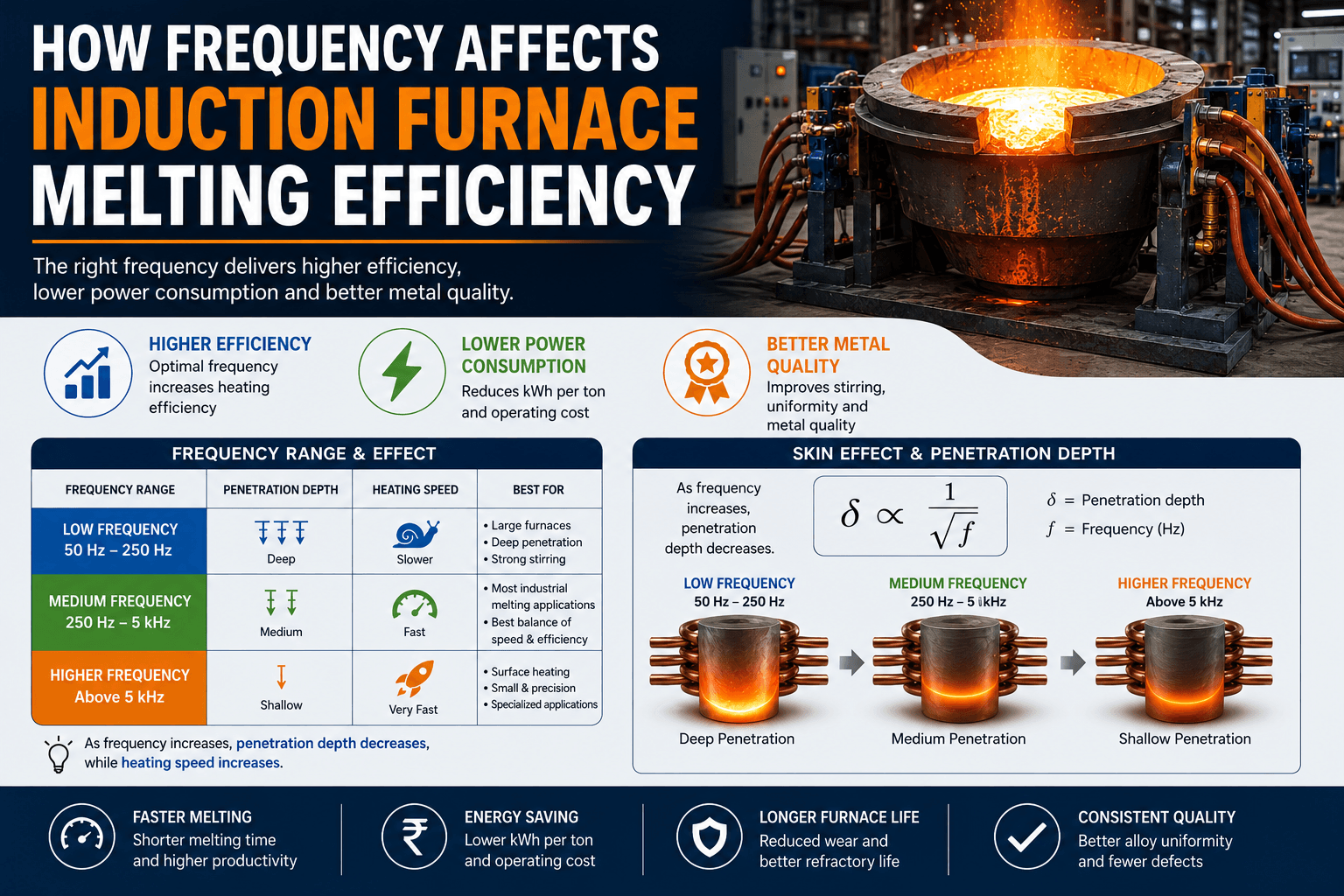
Higher frequencies cause current to concentrate near the surface of the metal, while lower frequencies allow current to penetrate deeper into the charge.
The relationship is often expressed as:
δ∝1f\delta \propto \frac{1}{\sqrt{f}}δ∝f1
Where:
- δ = penetration depth
- f = frequency
This means that as frequency increases, penetration depth decreases.
Effect of Frequency on Melting Efficiency
Low Frequency (50 Hz – 250 Hz)
Advantages:
- Deep penetration into large metal charges
- Strong electromagnetic stirring
- Suitable for large-capacity furnaces
Disadvantages:
- Slower initial heating
- Lower power density
Best For:
- Large steel melting furnaces
- Heavy charge materials
Medium Frequency (250 Hz – 5,000 Hz)
Advantages:
- Excellent balance between penetration and heating speed
- High electrical efficiency
- Faster melting cycles
- Better control of molten metal quality
Best For:
- Steel and iron foundries
- Brass and copper melting
- General-purpose induction melting operations
This is why the medium frequency furnace is the most widely used technology in modern foundries.
High Frequency (Above 5 kHz)
Advantages:
- Very rapid surface heating
- Precise temperature control
Disadvantages:
- Limited penetration depth
- Less suitable for large melting volumes
Best For:
- Surface hardening
- Small precision melting applications
Frequency vs Furnace Capacity
| Furnace Capacity | Typical Frequency Range |
|---|---|
| 100 kg – 500 kg | 1 kHz – 5 kHz |
| 1 ton – 5 tons | 500 Hz – 3 kHz |
| 5 tons – 20 tons | 250 Hz – 1 kHz |
| Above 20 tons | 50 Hz – 500 Hz |
Larger furnaces generally use lower frequencies to ensure adequate penetration and strong stirring throughout the metal bath.
Impact on Power Consumption
Choosing the correct induction furnace frequency can significantly reduce energy consumption.
Benefits include:
- Faster melting times
- Lower kWh per ton
- Reduced oxidation losses
- Improved alloy uniformity
- Better refractory life
An improperly selected frequency may cause uneven heating, excessive power losses, and higher operating costs.
Electromagnetic Stirring and Metallurgical Benefits
Lower frequencies generate stronger electromagnetic forces, which create natural stirring within the molten metal.
This improves:
- Temperature uniformity
- Alloy homogenization
- Inclusion removal
- Chemical consistency
However, excessive stirring can increase lining wear, so frequency must be selected carefully.
Typical Energy Consumption
A properly tuned medium frequency furnace can achieve:
- Steel: 550–700 kWh per ton
- Cast Iron: 500–650 kWh per ton
- Copper Alloys: 350–550 kWh per ton
- Aluminum: 500–650 kWh per ton
Actual results depend on furnace condition, charge quality, and cooling system performance.
How to Select the Right Frequency
When choosing an induction furnace frequency, consider:
- Metal type
- Furnace capacity
- Desired melting rate
- Stirring requirements
- Energy efficiency goals
- Power supply design
Working with an experienced furnace manufacturer or spare parts supplier helps optimize these parameters for maximum performance.
Conclusion
Induction furnace frequency has a direct and significant impact on melting efficiency. Lower frequencies provide deeper penetration and stronger stirring, while higher frequencies deliver faster surface heating. The medium frequency furnace offers the ideal combination of speed, efficiency, and metallurgical control for most foundry applications.
By selecting the correct frequency, foundries can reduce power consumption, improve metal quality, and maximize productivity.
Frequently Asked Questions
What is the best frequency for steel melting?
Most steel melting applications use medium frequencies between 500 Hz and 3 kHz.
Why is medium frequency furnace technology popular?
It provides an excellent balance between heating speed, penetration depth, and energy efficiency.
Does higher frequency always mean faster melting?
Not necessarily. Higher frequency increases surface heating but reduces penetration depth, which may be less efficient for larger charges.
How does frequency affect energy consumption?
Proper frequency selection lowers kWh per ton and shortens melting cycles, improving overall efficiency.
Optimize Your Furnace Performance Today with Electro Power Enterprise
Electro Power Enterprise, a leading induction furnace spare parts supplier and manufacturer in Ahmedabad, Gujarat, has over 30 years of experience helping foundries, steel plants, and furnace operations optimize their melting systems. We supply more than 200 induction furnace spare parts and provide expert repair services for all major furnace components—from transformers and coils to water-cooled cables and control systems.
Whether you need spare parts for routine maintenance, emergency repairs, or system optimization, we delivers: Complete induction furnace spare parts inventory for immediate availability, Expert diagnosis of frequency-related performance issues, Custom repair services for transformers, CLR, DI/DT reactors, and coils.
Don’t let inefficient frequency settings drain your profits. Contact Electro Power Enterprise today to discuss your furnace needs and discover how the right spare parts and expert guidance can maximize your melting efficiency. Call +91 76003 43075, email info@electropowerenterprise.in, or visit our website to get a free consultation on your induction furnace performance.

Rajesh Baraiya, Founder of Electro Power Enterprise, is passionate about making induction furnaces run more efficiently and last longer. Backed by three decades of hands-on experience, He provides practical insights into Induction furnace spare parts, enabling industries to achieve higher efficiency and longer furnace life.