Applications of Induction Furnaces in Steel Industries
Introduction
The steel industry relies heavily on efficient and reliable melting technologies to meet growing production demands. Among the various melting systems available today, Induction Heating induction furnaces have become one of the most preferred solutions for steel manufacturing due to their energy efficiency, fast melting speed, and environmentally friendly operation.
Induction furnaces are widely used in steel plants, foundries, casting industries, and metal processing units for melting and refining steel with precise temperature control and reduced metal losses.
What is an Induction Furnace?
An induction furnace is an electrical furnace that melts metal using electromagnetic induction. Instead of using fuel combustion, the furnace generates heat directly inside the metal through induced electrical currents.
The heating principle is based on:
P=I2RP = I^2RP=I2R
Where:
- P = Heat generated
- I = Induced current
- R = Resistance of the metal
This process allows steel to melt quickly and efficiently with minimal contamination.
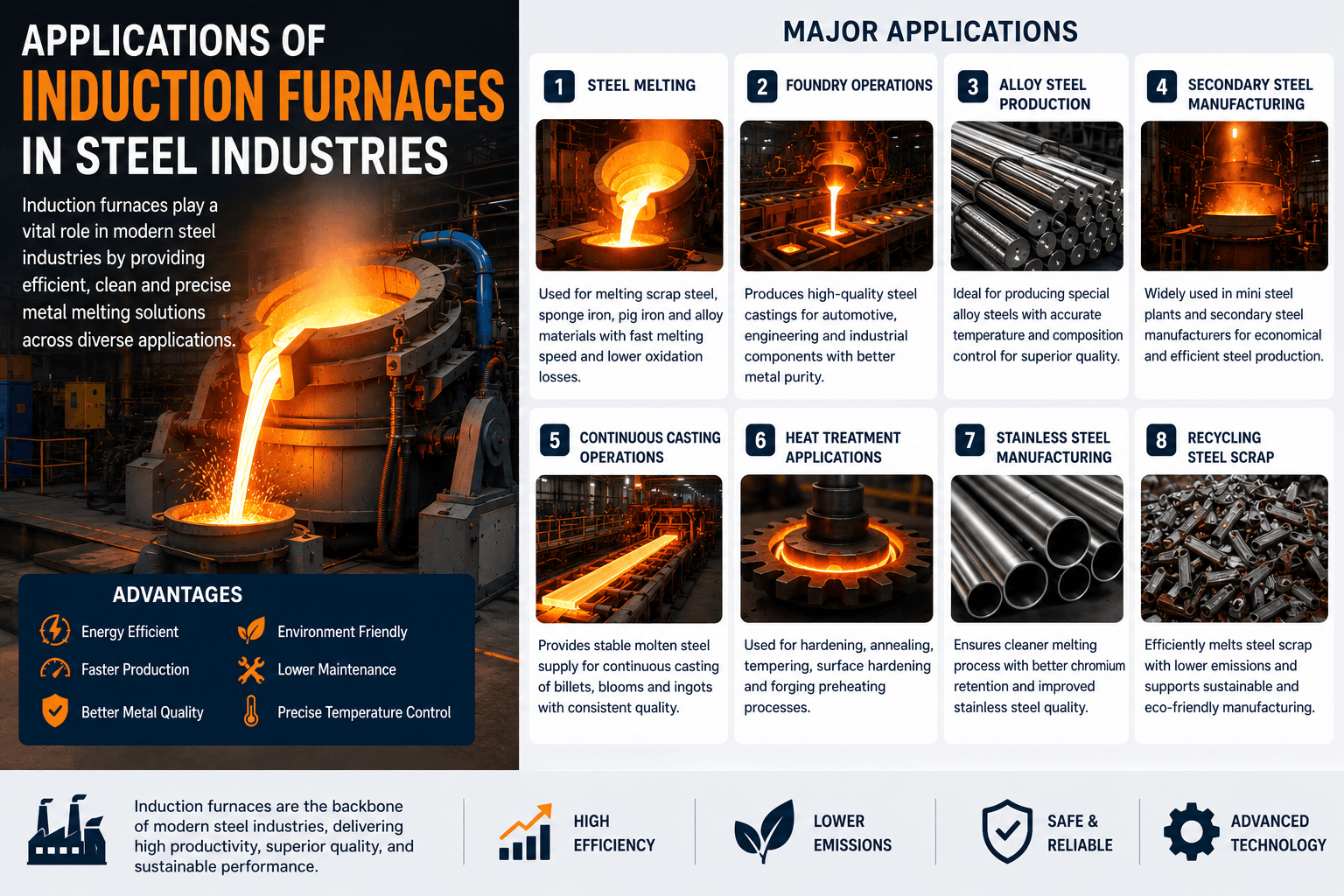
Major Applications of Induction Furnaces in Steel Industries
Steel Melting
The primary application of induction furnaces in the steel industry is melting scrap steel, sponge iron, pig iron, and alloy materials.
Benefits:
- Fast melting process
- Uniform heating
- Lower oxidation losses
- Better chemical composition control
- Reduced fuel dependency
Induction furnaces are commonly used for:
- Mild steel melting
- Stainless steel production
- Alloy steel manufacturing
- Tool steel melting
Foundry Operations
Steel foundries use induction furnaces to produce castings with high precision and superior metallurgical quality.
Applications in Foundries:
- Automotive components
- Pump and valve castings
- Engineering parts
- Industrial machinery components
Induction furnaces provide:
- Clean melting conditions
- Better metal purity
- Consistent pouring temperature
- Reduced casting defects
Alloy Steel Production
Induction furnaces are ideal for producing special alloy steels because they provide accurate temperature and composition control.
Common Alloy Applications:
- Chromium steel
- Nickel steel
- Manganese steel
- High-speed steel
- Heat-resistant alloys
The furnace environment helps maintain alloy composition with minimal contamination.
Secondary Steel Manufacturing
Many mini steel plants and secondary steel manufacturers use medium-frequency induction furnaces for economical steel production.
Common Raw Materials:
- Scrap steel
- Sponge iron
- Ferroalloys
- Return scrap
This process is highly popular in developing industrial regions because of:
- Lower installation cost
- Smaller space requirement
- Easier operation
- Lower maintenance costs
Continuous Casting Operations
Induction furnaces support continuous casting systems by supplying molten steel at controlled temperatures.
Advantages:
- Stable molten metal supply
- Better productivity
- Reduced thermal fluctuations
- Improved casting quality
Continuous casting applications are widely used in:
- Billet manufacturing
- Bloom casting
- Ingot production
Heat Treatment Applications
Induction heating technology is also used in steel industries for heat treatment processes.
Heat Treatment Processes:
- Hardening
- Annealing
- Tempering
- Surface hardening
- Forging preheating
Induction heating provides:
- Localized heating
- Fast process time
- Reduced energy consumption
- Better process control
Stainless Steel Manufacturing
Induction furnaces are highly effective for stainless steel production because they minimize contamination and oxidation.
Key Advantages:
- Cleaner melting process
- Controlled carbon levels
- Better chromium retention
- Improved product quality
Industries producing kitchenware, medical equipment, and industrial stainless-steel products widely use induction melting systems.
Recycling Steel Scrap
Steel recycling is one of the fastest-growing applications of induction furnaces.
Why Induction Furnaces are Ideal for Recycling:
- Efficient scrap melting
- Lower environmental pollution
- Reduced carbon emissions
- Lower operating costs
The recycling process helps industries reduce raw material consumption while supporting sustainable manufacturing.
Advantages of Induction Furnaces in Steel Industries
Energy Efficiency
Induction furnaces convert electrical energy directly into heat with high efficiency.
Faster Production
Quick melting increases production output and reduces cycle time.
Environment Friendly
No smoke, combustion gases, or fuel burning.
Better Metal Quality
Reduced impurities and oxidation improve steel quality.
Lower Maintenance
Fewer moving parts compared to conventional furnaces.
Precise Temperature Control
Essential for producing high-grade steel and special alloys.
Common Components Used in Steel Industry Induction Furnaces
Important components include:
- Induction coils
- Water-cooled cables
- Thyristors and SCR modules
- Capacitor banks
- Reactor coils
- Semiconductor fuses
- Copper tubes
- Cooling towers
- Mica insulation products
- FRP support structures
High-quality spare parts are essential for stable furnace operation and long equipment life.
Future of Induction Furnaces in Steel Manufacturing
With rising energy costs and environmental regulations, induction furnaces are becoming increasingly important in modern steel plants.
Future Trends:
- Smart automation systems
- IoT-based furnace monitoring
- Energy-efficient power supplies
- Improved refractory technologies
- AI-based predictive maintenance
The global shift toward sustainable steel production is expected to further increase the demand for induction furnace technology.
Conclusion
Induction furnaces have transformed modern steel manufacturing by providing cleaner, faster, and more energy-efficient melting solutions. From steel melting and alloy production to recycling and heat treatment, induction furnaces play a critical role across multiple steel industry applications.
Their ability to deliver precise temperature control, improved metal quality, and environmentally friendly operation makes them one of the most preferred technologies in today’s steel manufacturing sector.
As the steel industry continues to modernize, induction furnace technology will remain a key driver of efficient and sustainable production.

Rajesh Baraiya, Founder of Electro Power Enterprise, is passionate about making induction furnaces run more efficiently and last longer. Backed by three decades of hands-on experience, He provides practical insights into Induction furnace spare parts, enabling industries to achieve higher efficiency and longer furnace life.