Induction Furnace Copper Components: Complete Guide to Tubes, Rope & Busbars
In today’s metal melting and steel manufacturing industry, induction furnaces are widely used for their efficiency and precision. However, the performance of any furnace depends heavily on the quality of its core components—especially copper-based parts.
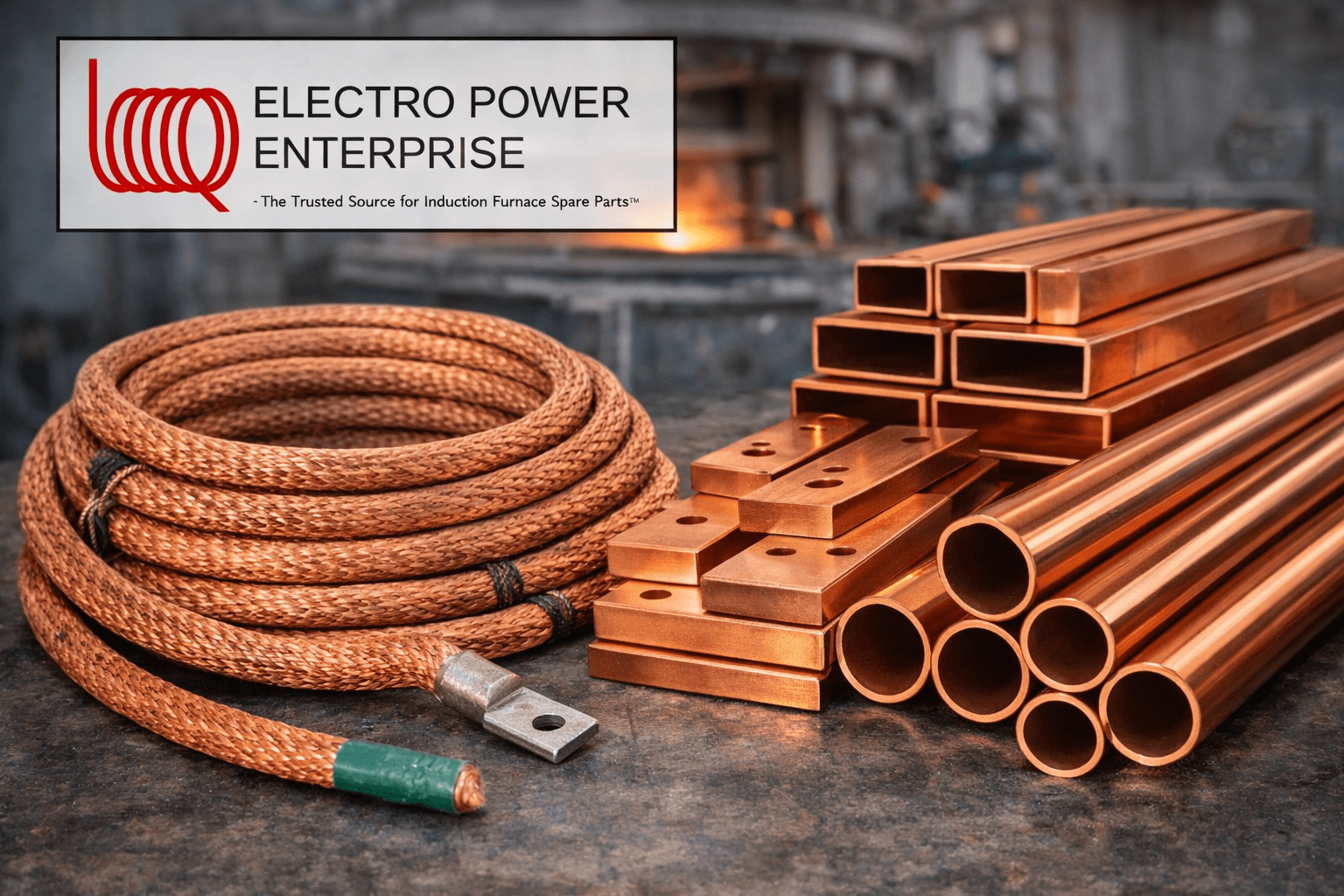
Key components such as copper tubes, rectangular copper sections, copper rope (flexible conductors), and copper busbars are essential for efficient furnace operation. These are widely used in induction furnace coils, lamination yokes, CLR, DC chokes, DI/DT reactors, and water-cooled cables.
If you are searching for a reliable supplier of copper components for induction furnaces, this detailed guide will help you understand everything.
Why Copper is Critical in Induction Furnace Systems
Copper is the backbone of electrical and thermal performance in furnaces due to:
- High electrical conductivity
- Excellent heat dissipation
- Strong mechanical properties
- Long service life
👉 This makes copper ideal for:
- Induction Furnace Coil
- Water-Cooled Cable
- Busbar Systems
- Reactors & Chokes
1. Copper Tubes for Induction Furnace: The Lifeblood of the Induction Coil
Copper tubes are primarily used in induction furnace coils and cooling systems. When it comes to induction coil fabrication, Hollow Copper Tubes are the industry standard.
Why Hollow?
Due to the Skin Effect in high-frequency induction, current primarily flows on the outer surface of a conductor. By using a hollow profile, manufacturers achieve two things:
- Weight Reduction: Removing the unused “inner” copper reduces costs.
- Active Cooling: It allows for high-velocity water cooling directly through the conductor, preventing the coil from reaching its melting point.
Features:
- EC Grade Copper (99.9%)
- Water-cooling compatibility
- High conductivity
Applications:
- Induction Furnace Coil
- Cooling systems
Benefits:
- Prevents overheating
- Improves efficiency
- Ensures long life
2. Rectangular Copper Tube / Section: Engineering for High Flux
Rectangular copper sections are used for advanced coil designs. For heavy-duty industrial furnaces, Rectangular Copper Sections (or “Square Copper Tubes”) are often preferred over round ones.
- Higher Packing Factor: Rectangular profiles minimize the “air gap” between coil turns. This increases the magnetic flux density, leading to faster melt times.
- Mechanical Integrity: The flat surfaces provide a better foundation for refractory lining and insulation, reducing the risk of coil vibration and noise.
- Custom Dimensions: Unlike standard round pipes, rectangular sections can be customized in aspect ratio to match specific frequency requirements.
Features:
- Better current distribution
- Increased cooling surface
Applications:
- High-capacity induction furnaces
Benefits:
- Compact design
- Higher efficiency
3. Water-Cooled Copper Rope: The Flexible Power Link
Copper rope is a highly flexible conductor made of multiple fine copper strands. A tilting furnace requires a flexible electrical connection. This is where Copper Ropes (used in Water-Cooled Cables) become indispensable.
Performance Benefits:
- Flexibility: Comprised of hundreds of fine-gauge copper wires, these ropes withstand thousands of tilt cycles without fatigue cracking.
- Thermal Management: These ropes are housed inside reinforced rubber sleeves where cooling water circulates directly over the strands.
- Low Impedance: Proper braiding techniques ensure that the cable maintains low inductance, which is critical for maintaining the power factor of the furnace.
Features:
- High flexibility
- Excellent conductivity
- Strong current carrying capacity
One of the most critical applications of copper rope is in water-cooled cables used in induction furnaces.
What is a Water-Cooled Cable?
Water-cooled cables are used to carry high current from power supply to induction furnace coil, while maintaining safe operating temperature through internal water circulation.
Role of Copper Rope in Water-Cooled Cable:
- Acts as the main current carrying conductor
- Provides flexibility for movement and vibration
- Ensures uniform current distribution
- Supports efficient heat dissipation
Why Copper Rope is Used Instead of Solid Conductor?
✔ High Flexibility – Prevents damage due to movement
✔ Better Heat Dissipation – Multiple strands increase surface area
✔ Reduced Mechanical Stress – Ideal for dynamic applications
✔ Improved Safety – Lower risk of cracking or failure
Applications:
- Induction Furnace Water-Cooled Cables
- Power Supply Connections
- High-current flexible links
Common Issues in Copper Rope (Water-Cooled Cable):
- Strand breakage
- Overheating due to poor cooling
- Leakage in cable insulation
- Corrosion due to poor water quality
Solutions:
- Use high-quality EC-grade copper rope
- Maintain proper water flow
- Inspect cable regularly
- Replace damaged cables immediately
4. Copper Busbar: The Efficient Power Distribution System
Copper busbars are used for efficient power distribution. Copper Busbars act as the high-capacity “highway” connecting the power supply (inverter/transformer) to the furnace.
- Low Resistance ($R$): Thick, solid busbars minimize energy loss through heat (P = I^2R).
- Durability: Unlike cables, busbars are rigid and long-lasting, requiring minimal maintenance over decades of service.
- Surface Treatment: To prevent oxidation and ensure low contact resistance, quality busbars are often Tin-Plated or Silver-Plated at the joints.
Features:
- High conductivity
- Durable design
Applications:
- Furnace power supply
- Lamination yoke
- CLR, DC choke, DI/DT
Benefits:
- Low power loss
- Long life
Complete Applications of Copper Components
Copper components are used in:
- Induction Furnace Coil
- Water-Cooled Cable
- Lamination Yoke
- CLR (Current Limiting Reactor)
- DC Choke
- DI/DT Reactor
Problems with Low-Quality Copper Components
Using poor-quality copper leads to:
- Overheating
- Frequent furnace repairs
- High energy loss
- Reduced equipment life
Why Quality Copper is Important
- Improves efficiency
- Reduces downtime
- Minimizes induction furnace repair
- Ensures safe operation
Why Choose Electro Power Enterprise?
We are a trusted manufacturer and supplier of:
✔ Copper Tubes
✔ Rectangular Copper Sections
✔ Copper Rope (for Water-Cooled Cable)
✔ Copper Busbars
✔ Induction Furnace Spare Parts
✅ Our Strength:
- EC Grade Copper (99.9%)
- Custom manufacturing
- Fast delivery
- Industry expertise
Maintenance Tips
- Maintain proper cooling
- Check copper rope condition regularly
- Avoid overheating
- Replace damaged parts on time
Conclusion
Copper components play a crucial role in induction furnace performance. Among them, copper rope used in water-cooled cables is one of the most critical elements, ensuring safe and efficient power transmission.
Using high-quality copper components helps reduce breakdowns, minimize furnace repairs, and improve overall productivity.
Contact Electro Power Enterprise
📞 +91 7600343075
📧 info@electropowerenterprise.in
✔ Copper Tubes
✔ Copper Rope for Water-Cooled Cable
✔ Copper Busbars
✔ Furnace Spare Parts
Also Read: Inductotherm Busbar & Busbar Adaptor: Complete Guide

Rajesh Baraiya, Founder of Electro Power Enterprise, is passionate about making induction furnaces run more efficiently and last longer. Backed by three decades of hands-on experience, He provides practical insights into Induction furnace spare parts, enabling industries to achieve higher efficiency and longer furnace life.