Induction Furnace Heat Exchanger Guide: Design, Types, Working Principle & Maintenance
Introduction
In the world of metal melting, efficient cooling is as critical as the electrical power itself. High-frequency currents, sophisticated power electronics, water-cooled cables, and the induction coil itself generate intense, constant heat. To manage this significant thermal load, the Induction Furnace Heat Exchanger is an indispensable component, vital for maintaining system stability, safety, and productivity.
Whether you operate coreless induction furnaces, channel furnaces, or high-power induction melting systems, a properly designed and maintained heat exchanger guarantees uninterrupted melting, extends component lifespan, and significantly lowers operational costs.
At Electro Power Enterprise, we are specialists in manufacturing and supplying robust induction furnace heat exchangers and complete cooling system components, engineered specifically for the demanding environment of induction furnace applications worldwide.
What is an Induction Furnace Heat Exchanger?
An induction furnace heat exchanger is a dedicated cooling device designed to facilitate the rapid and safe transfer of heat. It removes heat from the hot process water (circulating through coils, power supplies, SCRs, IGBTs, transformers, and bus bars) and transfers it to a secondary, external cooling medium, typically ambient air or cooling tower water.
Primary Purpose:
- Heat Removal: Efficiently extract excess heat from the furnace cooling water.
- Temperature Control: Maintain stable, safe operating temperatures for all critical electrical and mechanical components.
- Preventive Protection: Guard against coil damage, power supply failure, and catastrophic overheating events.
Why Cooling is Critical: The Role of the Induction Furnace Cooler
Induction furnaces operate under extreme electrical and thermal stress. Without highly effective heat dissipation provided by the induction furnace cooling system:
- Coil Failure: Copper coils and refractories can overheat, leading to premature failure and costly relining.
- Power Trips: Sensitive power supply components (SCRs / IGBTs) will quickly reach their thermal limit and trip, halting production.
- Reduced Efficiency: Elevated water temperatures dramatically decrease the cooling efficiency of the entire system.
- Downtime: Unscheduled furnace downtime increases dramatically.
A correctly sized and high-performance Induction Furnace Heat Exchanger ensures:
- Stable & Continuous Melting Cycles
- Consistent Furnace Performance and energy transfer.
- Extended operational life for expensive coils, cables, hoses, and electronics.
The Working Principle of Induction Furnace Heat Transfer
The heat exchanger operates on a highly efficient closed-loop cooling principle to isolate the furnace water:
- Heat Collection: Hot water exits the induction coil, power supply, or transformer.
- Heat Exchange Entry: This hot, contaminated water enters the heat exchanger.
- Heat Transfer: Heat is efficiently transferred to the external medium:
- Ambient air (in an Air-Cooled Heat Exchanger), or
- Cooling tower water (in a Water-to-Water Heat Exchanger).
- Recirculation: The now-cooled, clean water is continuously recirculated back to the furnace system.
This continuous, protected cycle maintains system temperatures within crucial safe limits.
Types of Heat Exchangers for Induction Furnace Systems
Selecting the correct type is essential for matching the furnace’s capacity and operational environment.
Air-Cooled Heat Exchanger (Radiator Type)
- Uses powerful fans to dissipate heat directly into the atmosphere.
- Key Benefit: Ideal for regions with limited or expensive water resources. Low maintenance and environmentally friendly (closed-loop).
- Common Use: Induction power supply cooling, medium-frequency induction furnaces.
Water-to-Water Heat Exchanger
- Transfers heat from the furnace’s closed-loop water to a second, external open-loop source (e.g., cooling tower).
- Key Benefit: Extremely high efficiency for large melting capacities. Compact design for high heat loads.
- Common Use: High-capacity induction furnaces and continuous foundry operations.
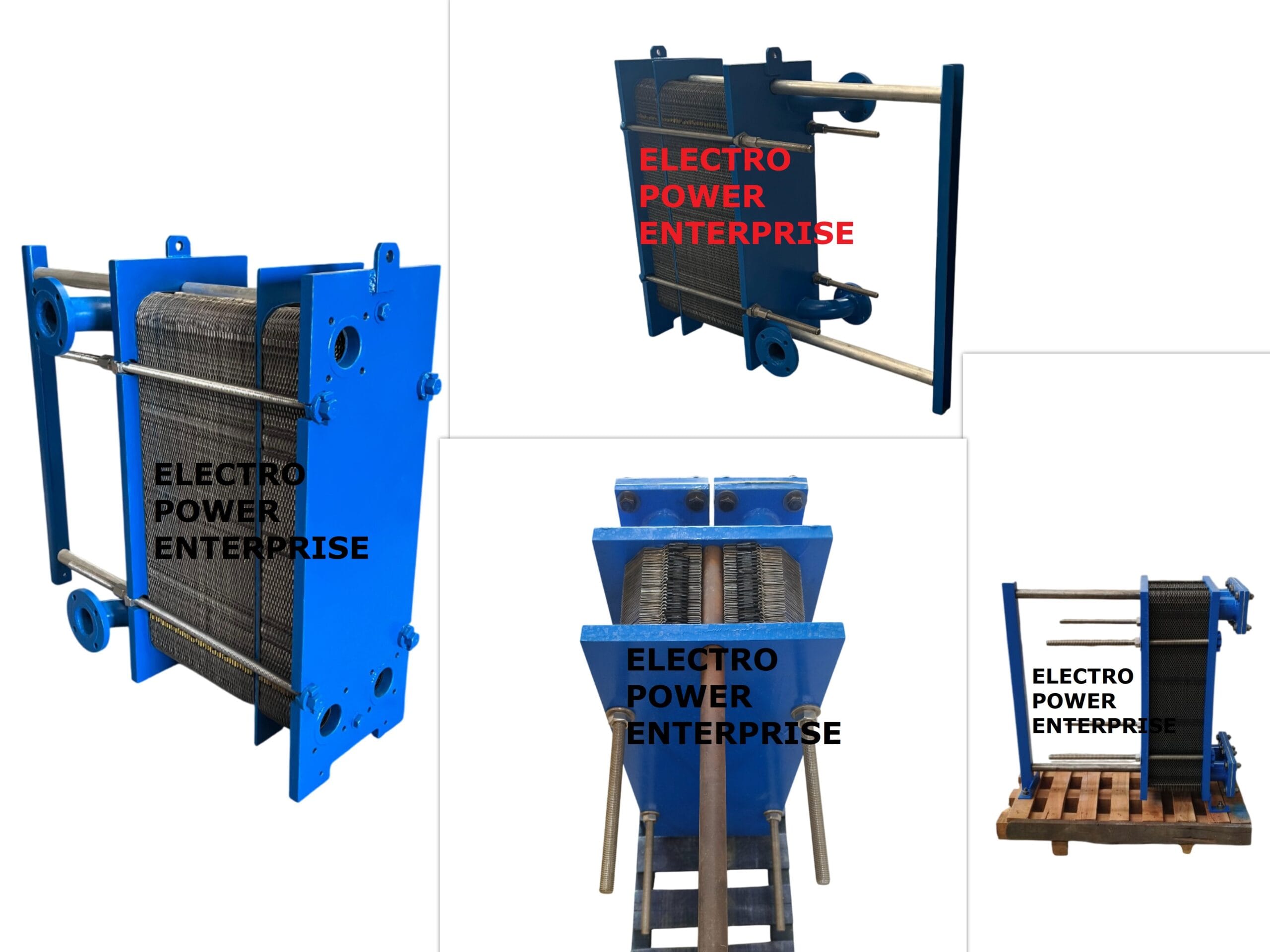
Plate Type Heat Exchanger (PHE)
- Utilizes thin metal plates to create a compact area for high-efficiency heat transfer.
- Key Benefit: High thermal efficiency, small footprint, and easy to clean or expand by adding more plates.
Shell & Tube Heat Exchanger
- A robust, heavy-duty industrial design where fluid runs through tubes encased in a shell.
- Key Benefit: Handles high flow rates and high pressures reliably, offering a very long service life.
Key Components of a Complete Cooling System Assembly
A fully functional system goes beyond the heat exchanger core:
- Copper or stainless steel tubes / plates
- High-power cooling fans (for air-cooled units)
- Temperature sensors and gauges
- Flow switches (essential for safety interlocks)
- Pressure gauges
- Expansion tank
- Filtration unit (critical for water quality)
Electro Power Enterprise supplies complete cooling system assemblies, including the heat exchanger, robust hoses, flow switches, and precise temperature sensors, tailored to your furnace specifications.
Selecting and Maintaining Your Induction Furnace Cooler
Required Details for Heat Exchanger Sizing
When designing or selecting your induction furnace cooler, precise data is mandatory. Improper sizing leads to overheating, scaling, and reduced efficiency. We require:
- Furnace capacity (in kg or tons).
- A picture of the furnace nameplate (to verify specifications).
- Required number of plates/tubes or target cooling capacity.
Common Problems & Essential Maintenance Tips
Issue | Cause | Maintenance Best Practice |
|---|---|---|
Scaling | Hard water or mineral buildup. | Use treated, soft, or demineralized water only. Clean the system periodically with non-corrosive chemicals. |
Blockage | Dirty water or lack of filtration. | Install and maintain an effective filtration unit. Clean tubes/plates regularly. |
Reduced Efficiency | Low flow rate or air in the system. | Monitor and maintain the proper water flow rate. Bleed air from the system completely. |
Leakage | Corrosion or worn gaskets. | Inspect seals, gaskets, and fittings during scheduled shutdowns. Replace aging hoses. |
Pro Tip: Implementing a proactive, preventive maintenance schedule can increase your heat exchanger’s operational life by 30–40% and prevent expensive emergency shutdowns.
Benefits of Investing in a High-Quality Heat Exchanger
Benefit Category | Description |
|---|---|
Financial Savings | Reduced component maintenance and replacement costs. |
Performance | Improved furnace efficiency and stable melting temperatures. |
Safety & Uptime | Protection of expensive components, drastically minimizing unscheduled furnace downtime. |
Sustainability | Energy-efficient operation through optimized thermal management. |
Why Choose Electro Power Enterprise for Your Cooling Needs?
At Electro Power Enterprise, we are solely focused on power and cooling solutions for the induction industry. We specialize in:
- High-performance induction furnace heat exchangers.
- Complete, customized cooling system solutions.
- Custom-designed units for OEMs and high-volume foundries.
- Compatibility guaranteed with leading global furnace brands, including Inductotherm, Electrotherm, Megatherm, and others.
We serve foundries and induction furnace users across Mexico, Asia, Europe, the Middle East, Africa, and the Americas, providing reliable solutions globally.
Conclusion
A reliable induction furnace heat exchanger is not merely a cooling accessory—it is a critical safety and performance component that dictates the success and longevity of your melting operations. Choosing the right type, maintaining rigorous water quality standards, and ensuring correct sizing will dramatically improve furnace uptime and overall efficiency.
For high-performance, durable induction furnace spare parts and cooling systems, trust Electro Power Enterprise—your global partner in induction furnace reliability.

Rajesh Baraiya, Founder of Electro Power Enterprise, is passionate about making induction furnaces run more efficiently and last longer. Backed by three decades of hands-on experience, He provides practical insights into Induction furnace spare parts, enabling industries to achieve higher efficiency and longer furnace life.