Average Life of Water Cooled Cable in Indian Conditions (Based on 10000+ Repairs)
In an ideal environment, a water cooled cable used in an induction furnace is expected to perform reliably for 3 to 5 years. This assumption is often based on laboratory conditions, controlled water quality, stable power supply, and proper installation practices.
However, the reality in Indian industrial conditions is very different.
Based on our experience of 10000+ repair and service cases across multiple industries, the actual lifespan of water cooled cables is significantly lower than expected. In fact, premature failure has become so common that many furnace operators assume frequent replacement is “normal”—which is not true.
This article breaks down real-world data, practical observations, and field insights to help you understand:
- The true average life of water cooled cables in India
- Why failures happen earlier than expected
- What warning signs you should never ignore
- How you can significantly extend cable life
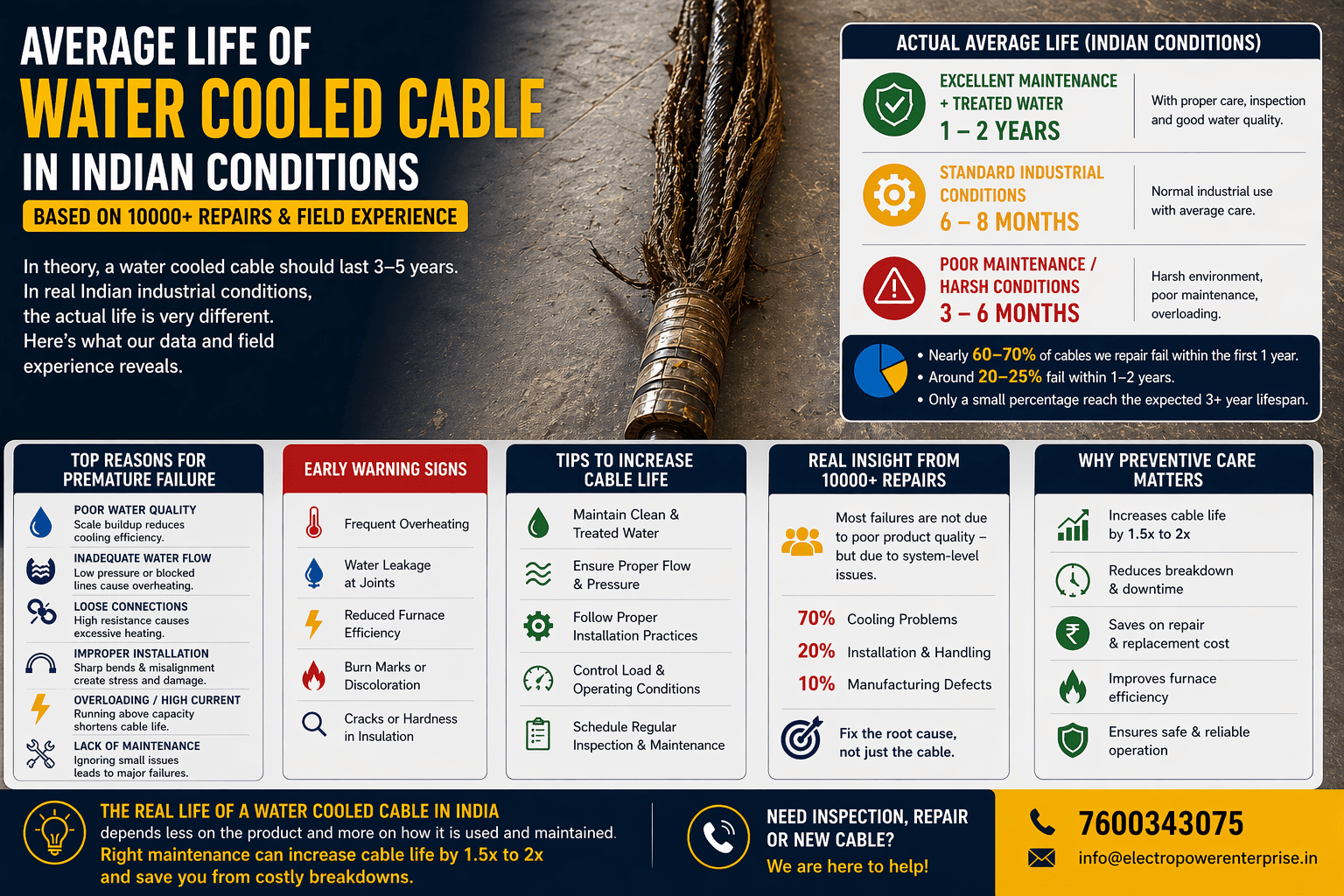
Actual Average Life – What Field Data Shows
Let’s move beyond assumptions and look at actual patterns observed from thousands of repairs:
| Operating Condition | Average Cable Life |
|---|---|
| Excellent maintenance + treated water | 1 – 2 years |
| Standard industrial conditions | 6 – 8 months |
| Poor maintenance / harsh conditions | 3 – 6 months |
From our repair database:
- Nearly 60–70% of cables fail within the first 1-2 years
- Around 20–25% fail within just 8 months
- Only a small percentage reach the expected 2+ year lifespan
This clearly indicates that environment and usage matter more than theoretical design life
1. Water Quality Issues (Biggest Hidden Killer)
In many Indian plants, untreated or hard water is used in cooling systems. Over time, this leads to:
- Scale formation inside the cable
- Reduced internal diameter for water flow
- Localized overheating (hotspots)
Even a slight reduction in flow can drastically reduce cooling efficiency, especially under high current conditions.
Most operators underestimate this factor, but in our experience, over 40% of failures are linked to poor water quality
2. Inadequate Water Flow & Pressure
Water cooled cables are designed to operate within specific flow and pressure ranges.
Common issues we observe:
- Pump inefficiency
- Partially blocked pipelines
- Leakage in the system
- Uneven distribution
When flow is insufficient:
- Heat is not removed effectively
- Cable temperature rises gradually
- Insulation and copper both degrade faster
3. Improper Installation Practices
Installation mistakes are one of the most overlooked causes of failure.
Typical problems include:
- Sharp bending beyond recommended radius
- Misalignment with furnace terminals
- Mechanical stress on joints
- Poor clamping or support
These issues create:
- Internal stress points
- Weak zones prone to leakage or overheating
Many cables fail not because of manufacturing—but because of how they are installed.
4. Overloading & High Current Operation
In real production environments, furnaces are often pushed beyond rated capacity to increase output.
This leads to:
- Continuous high current flow
- Excessive heat generation
- Accelerated wear of insulation and conductor
If combined with poor cooling, failure becomes inevitable.
5. Lack of Preventive Maintenance
One of the most common patterns we see:
Small issues are ignored until they become major failures.
Examples:
- Minor leakage ignored → internal corrosion
- Slight temperature rise ignored → insulation damage
- Loose joint ignored → arcing and burn
Preventive maintenance is often skipped due to production pressure—but the long-term cost is much higher.
Early Warning Signs You Should Never Ignore
Recognizing early signs can save both cost and downtime:
Visible Signs:
- Cracks or hardness in outer insulation
- Water leakage at joints or bends
- Discoloration or burn marks
Performance Indicators:
- Frequent overheating alarms
- Reduced furnace efficiency
- Increased power consumption
- Fluctuating current readings
Ignoring these signs can reduce cable life by up to 50%
What Actually Happens Inside a Failing Cable
Understanding the failure mechanism helps in prevention.
Typical sequence:
- Reduced water flow (due to scaling or blockage)
- Localized heat buildup
- Gradual insulation degradation
- Copper conductor starts losing strength
- Micro-leakage begins
- Final failure (burst, burn, or breakdown)
Failure is rarely sudden—it is a progressive process
How to Increase Water Cooled Cable Life (Practical Methods)
1. Maintain Water Quality
- Use treated or filtered water
- Regularly clean cooling system
- Avoid hard water scaling
2. Monitor Flow & Pressure
- Install flow meters if possible
- Check pump performance regularly
- Ensure uniform distribution
3. Follow Proper Installation Practices
- Maintain recommended bending radius
- Avoid mechanical stress
- Use proper support and alignment
4. Control Operating Conditions
- Avoid continuous overloading
- Monitor current and temperature
- Maintain proper duty cycles
5. Schedule Regular Inspection
- Weekly visual checks
- Monthly detailed inspection
- Immediate action on minor issues
Following these steps can increase cable life by 1.5 to 2 times
Real Insights from 10000+ Repairs
Across thousands of cases, one pattern is clear:
Most failures are not due to poor product quality—but due to system-level issues
Key observations:
- 70% failures linked to cooling problems
- 20% due to installation and handling
- Only 10% due to manufacturing defects
This means:
Simply replacing the cable without fixing the root cause will not solve the problem
Cost Impact of Frequent Cable Failure
Many industries underestimate the true cost of failure:
- Production downtime
- Emergency repair expenses
- Increased power consumption
- Reduced furnace efficiency
- Safety risks
In some cases, the indirect cost of failure is 3–5 times higher than the cable cost itself
Conclusion
The lifespan of a water cooled cable in Indian conditions is not fixed—it depends heavily on:
- Water quality
- Cooling system performance
- Installation practices
- Operating discipline
While the theoretical life may be 2-3 years, the practical reality is often much lower due to avoidable factors.
The key takeaway is simple:
If you focus on system maintenance, you can significantly extend cable life and reduce overall cost.
Need Expert Support?
If you are facing:
- Frequent cable failures
- Overheating issues
- Reduced furnace performance
We provide:
- Inspection & troubleshooting
- Repair services
- Custom manufacturing of water cooled cables
📞 7600343075
📧 info@electropowerenterprise.in
Also Read: Water-Cooled Cables in Induction Furnaces – Types, Function, and Common Failures

Rajesh Baraiya, Founder of Electro Power Enterprise, is passionate about making induction furnaces run more efficiently and last longer. Backed by three decades of hands-on experience, He provides practical insights into Induction furnace spare parts, enabling industries to achieve higher efficiency and longer furnace life.